LOCATION: JOE CHARTRAND PARK - 200 ST. DAVID ST. NORTH NOËLVILLE, ON P0M 2N0
Artist: Jessica Somers
About the Mural
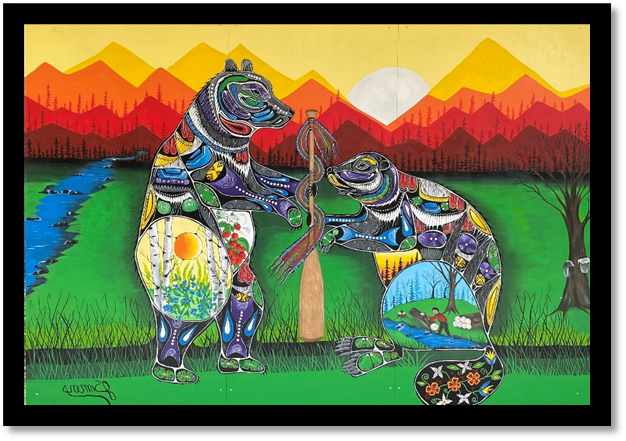
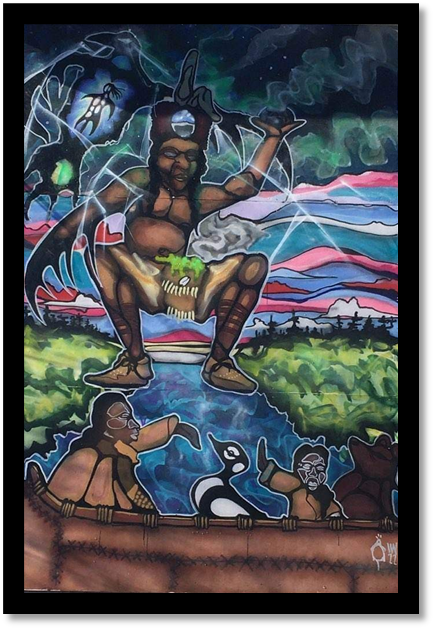
“United” was created after elder Richard Meilleur shared the history of two clans, the Beaver and Bear, who found their way to this land. The Beaver clan consisted of loggers, community builders, educators, family-oriented people, and very patient people. The Bear clan was known as protectors and keepers of medicine. They use their voice to fight for the rights of their people. Their kinship continues today, and the community stands strong together.
Meaning behind the Mural
Two ladies, one from the Beaver clan and the other from the Bear clan, encountered two Alquonkins travellers in the country's western region. They helped establish the Rocky Mountain Post in modern-day Alberta in 1799. In the early 1820s, the women of the Beaver and Bear clans wed those two Alquonkins. These women returned to Quebec with their husbands because they were interested in learning more about the eastern region of the nation. They were admitted into the two men's commune, known in French as "la Petite Nation," which at the time was primarily made up of mixed-blood people. Everything was great up until the second new wave of French and English immigrants settled in the mixed-blood town around 1850. As you can expect, full-blooded French and English newcomers did not want to mix with the Metis, so they drove them out by stealing their lands and farms. The Beaver clan made the decision to travel west in search of fresh territories to settle. They travelled down the Ottawa, Mattawa, and Nipissing rivers before stopping where those rivers meet the French River and establishing a settlement they called Monetville. The Beaver clan prospered greatly because they were loggers, community builders, educators, family-oriented, and very patient people. The beaver travelled quickly from Quebec because they are excellent swimmers. As they had to walk the majority of the trip, the Bear clan moved more slowly as they followed the Beaver clan. When the Bear clan arrived, the community was virtually complete. As a result, they immediately began to gather medications for the locals, watch over the area, and safeguard the locals, especially the young ones. To this day, they continue to fight for their community's rights. The Bear clan is a well-liked and tenacious clan. Today, the Beaver and Bear clan lives in harmony with all the other people in the same community. Three other kinship communities connect to Monetville, Noëlville, St-Charles and Alban.
Artist Biography - Jessica Somers
Elder Support: Richard Meilleur
Jessica Somers was born in Sudbury, Ontario, and currently resides in Lavigne, Ontario. She is Odanak Abenaki (full status), and her grandmother is also Metis. She is greatly influenced by her grandmother, who enjoyed creating scenic and wildlife paintings. Her father’s passion for carpentry, hard work ethic, and determination are what have attributed to her success as an artist today.
Jessica loves creating paintings that represent the knowledge of the natural world we learn and share through generations. She is captivated by the teachings of elders in her community and her Nation, and she creates art that connects to these teachings. This honors her ancestors while also ensuring the knowledge is passed on.
Jessica also provides workshops online and in person to engage the community by opening doors to create, educate and provide opportunities for community members to experience and benefit from Indigenous culture. She enjoys creating large murals with schools and organizations with community members to engage in community and the arts. Jessica believes that art is like language; it is a medium to express ideas and to share information. Art helps share thoughts, ideas and visions that may not be able to be articulated any other way. Art has a full range of expression. The process of creating art engages people mentally, physically, emotionally and spiritually. Jessica uses her artwork as self-reflection, a way of seeking peace, sharing knowledge, teaching lessons, and/r telling stories. Jessica believes that art has been a survivance, a way of holding onto stories and history, embodying a way of life and expressing and sharing Indigenous identities. It allows individuals a richer understanding of Indigenous history.